Freezer Repair
Sub-Zero Freezer Frost Keeps Coming Back After You Clean It
A sheet of frost that rebuilds on the freezer's back wall within a fortnight of every clean-out is a defrost circuit problem or a seal problem — and telling those two apart at home is easier than most owners expect.
Written by
Bjorn Aaltonen
Refrigeration technician — wine storage and dual zones · 15 years in the trade · EPA 608 certified
Treats a drifting wine zone as a question about air rather than about the compressor: damper travel first, then the fan, then the door. Logs a full day before condemning a control, because the fault is usually only present for part of it.
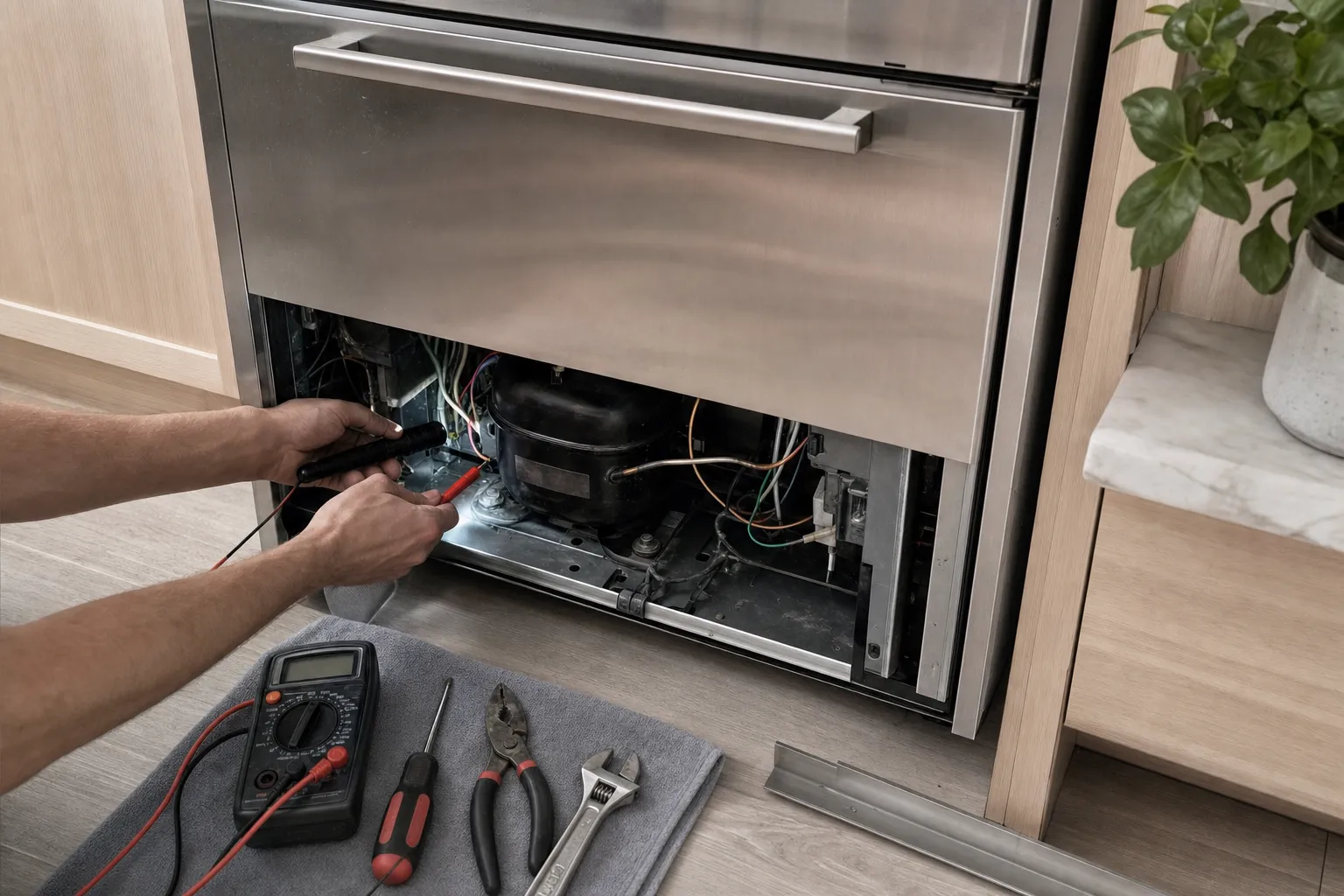
Frost that comes back is one of the most misread symptoms on a built-in freezer. The pattern is almost always the same: you empty the compartment, chip or thaw off the ice, everything looks correct for a week or two, and then the sheet on the back wall starts building again. Owners tend to conclude the freezer is simply old. It usually is not — a frost-free freezer that keeps frosting is telling you something specific, and there are only a few things it can be.
Reading the frost on the back wall
A Sub-Zero freezer is not supposed to accumulate visible frost anywhere you can see it. Moisture in the air condenses and freezes on the evaporator coil, which is deliberate — that is the coldest surface in the compartment and it is where you want the moisture to end up. Several times a day a heater warms that coil just enough to melt the accumulation, and the meltwater runs down a drain tube to a pan near the compressor where it evaporates away.
That cycle is invisible when it works. When you can see frost, one of two things is happening. Either far more moisture is entering the compartment than the design expects, or the melt part of the cycle is not happening and the coil is slowly icing up until the ice grows past the panel and into the space where your food is.
Which of those it is determines whether you are looking at a fifteen-minute adjustment or a genuine parts repair, so it is worth separating them before anyone quotes you.
The three parts of a defrost circuit
If the melt cycle has stopped, the fault is in one of three components, and they fail in roughly that order of frequency.
The defrost heater is a resistive element clipped to or threaded through the evaporator. It is the workhorse and it does eventually burn out. When it fails, nothing melts, and the ice builds cycle after cycle in a very even, layered way — that stratified look is characteristic.
The defrost terminator (or bimetal thermostat) is the safety that decides when the coil is warm enough and cuts the heater. When it fails open, the heater never energises even though it is perfectly good. This is the part that gets overlooked most often, because a technician who tests the heater in isolation and finds it healthy can talk themselves into replacing a control board instead.
The thermistor and control board decide when a defrost cycle should run at all. A drifting thermistor can convince the board the compartment is colder than it is, which alters both compressor run time and defrost scheduling. Board failure is real but genuinely uncommon, and it should be the last conclusion, not the first.
What you can check before booking
There are three things worth doing yourself, and each of them either fixes the problem or narrows it usefully.
Start by emptying the compartment and thawing it completely — twenty-four hours with the door open is more reliable than any shortcut. Note the date. This gives you a clean baseline, and how quickly the frost returns is diagnostic in itself. Back within a week points hard at the heater circuit. Back after a month points more towards moisture ingress.
Second, look at where the frost actually forms. Ice concentrated on the rear evaporator panel, uniform across it, is a defrost fault. Ice concentrated around the drawer edge, the door frame or the gasket line is moisture getting in, which is a different repair entirely.
Third, check what has changed. A new ice maker connection, a door that has been adjusted, a unit that was pulled out for a floor refinish, or simply a household that started opening the drawer far more often — any of these shift the moisture load. Bellevue kitchens with open-plan layouts and lots of summer door traffic run measurably wetter than the design assumption.
When frost is the door, not the defrost
Gasket failure is undramatic and easy to miss. The seal does not tear; it goes hard, loses its magnetic grip in one section, or gets pushed permanently out of shape by something stored against it. Air leaks in continuously, and the evaporator has to deal with far more moisture than it was designed for. It clears some of it, falls behind on the rest, and you get frost.
The paper test settles it. Close the drawer or door on a sheet of paper and pull it out. Do it at a dozen points around the perimeter. Where the paper slides out with no resistance, the seal is not sealing. On a full-height column, pay particular attention to the hinge side at the bottom, which is where the load concentrates and where seals usually go first.
The other door-side cause is alignment. Built-ins that have been removed and refitted — for a kitchen refresh, a floor replacement, a previous repair — can go back very slightly out of square. It looks fine and it does not seal.
What the repair usually costs you in time
A heater or terminator replacement is a same-visit job on most model families. The evaporator panel comes off, the failed part is replaced, the compartment is brought back down, and the unit is proved before anyone leaves. A gasket is similar in time but the part is model-specific and often has to be ordered against your serial number.
The thing worth avoiding is the shotgun approach: heater, terminator, thermistor and board replaced together because it is faster than testing. That is four parts billed to solve a one-part fault, and it is the single most common way owners end up with an inflated invoice on a machine that was straightforward.
If your frost is back within a fortnight of a full thaw, stop clearing it and get it tested properly. Repeated manual defrosting is treating a symptom that has a name, a cause and a specific part number behind it.
Asked after reading this
Is some frost normal inside a Sub-Zero freezer?
A light, even dusting on the evaporator panel between defrost cycles is normal and you will rarely see it. Visible frost on food, on the back wall or around the drawer runners is not normal on a frost-free built-in and means moisture is either getting in or not being cleared out.
Will unplugging the unit for 24 hours fix it?
A manual thaw clears the symptom and gives you a clean starting point, which is genuinely useful for diagnosis. It does not fix a failed heater, terminator or thermistor, which is why the frost is back within two or three weeks.
Can I keep using the freezer while it frosts up?
For a while, yes, but it gets worse in a predictable way. As the evaporator ices over, airflow drops, the compressor runs longer to hold temperature, and eventually the fresh-food side on a shared-evaporator model starts to suffer too.